
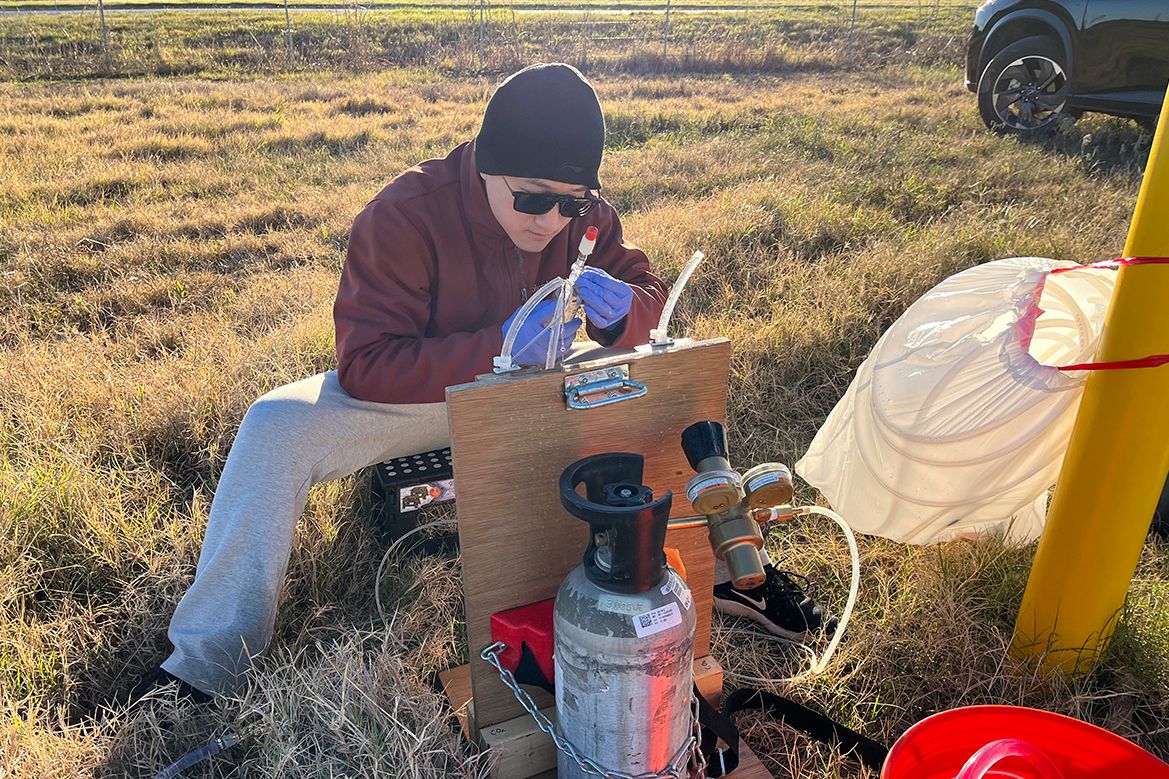
Microbes clean excess nitrogen out of water by turning it into nitrogen gas, but that gas has been nearly impossible to measure because water already holds a large amount of nitrogen dissolved from the air. A new study in Science, led by Jiarui Liu, a former EPSS Ph.D. student who carried out the research as a postdoctoral fellow at UCLA and UC Santa Barbara, shows that a rare form of nitrogen gas, in which both atoms are the heavy isotope nitrogen-15, works as a natural fingerprint for this microbial conversion. In air these heavy pairs occur more often than chance would predict, while microbes produce them almost at random, so the abundance of the rare molecule reveals how much nitrogen gas came from microbial activity. The team measured the gas with UCLA’s Panorama mass spectrometer, which is large enough to separate molecules with almost identical masses, and applied the method to groundwater in Texas, lakes in Antarctica and Minnesota, coastal basins off Southern California, the Bay of Bengal, and deep-sea sediments offshore from Alaska. EPSS geochemist Edward Young, Liu’s postdoctoral advisor at UCLA, is a co-author. The approach offers a new tool for assessing fertilizer and wastewater impacts on water quality and for refining estimates of the global nitrogen budget.
For the full story, please visit the UCLA Newsroom (opens in a new tab).