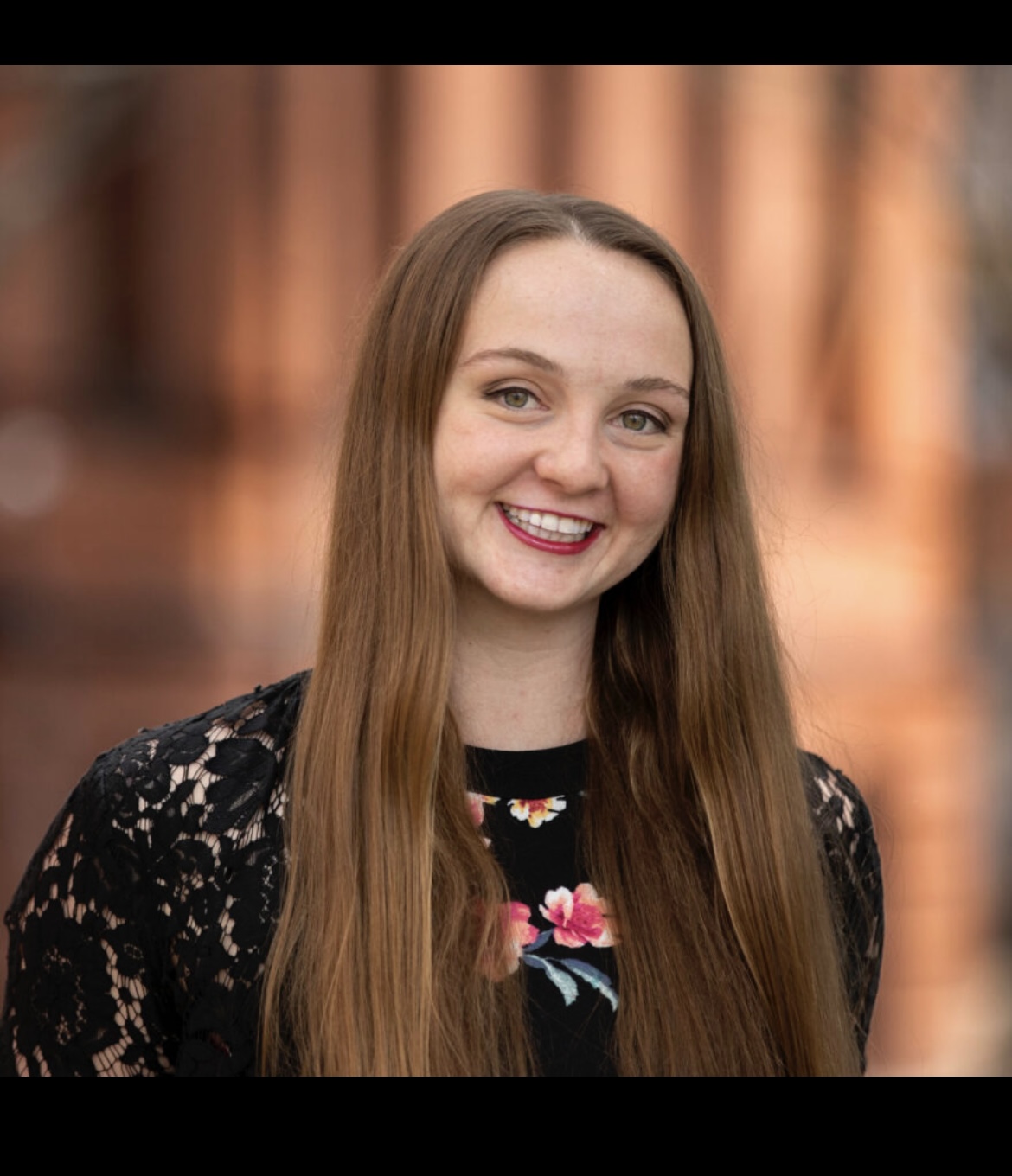
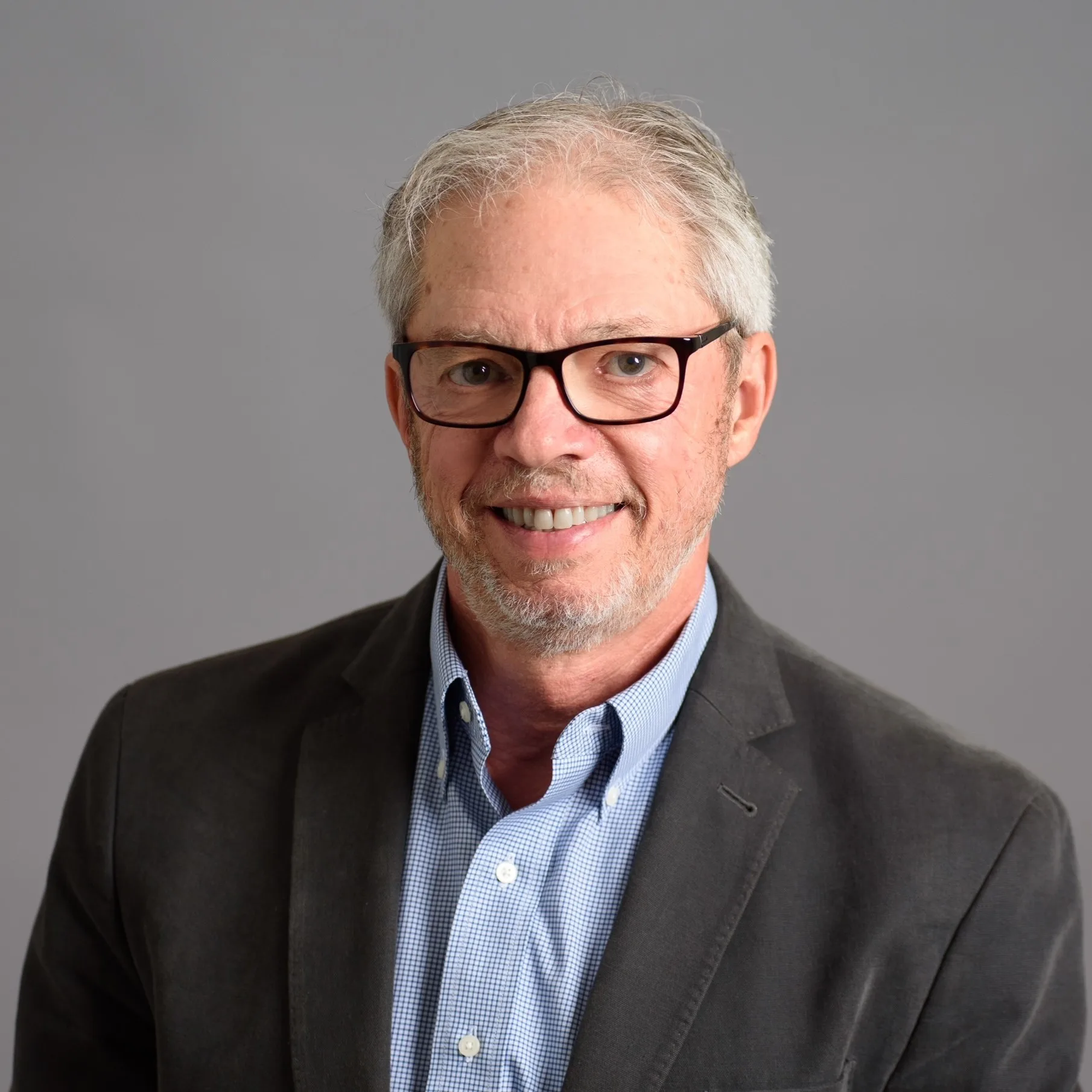
Danica Adams is a NASA Sagan Fellow at UCLA EPSS in Professor Hilke Schlichting’s group, and she was recently awarded the UCLA Chancellor’s Postdoctoral Fellowship. She is a photochemist with interest in planet evolution. With Dr. Schlichting, Danica is investigating how disequilibrium chemistry can explain JWST measurements of exoplanet atmospheres. Danica also conducts research in the solar system. There, she is passionate about when Mars and Venus could have hosted liquid water in their early histories and what atmospheric chemistry could have supported such climates. She obtained her B.A. in Planetary Science from UC Berkeley, and her PhD from Caltech. Before joining UCLA, she was a postdoctoral fellow at Harvard in the Wordsworth group for two years.
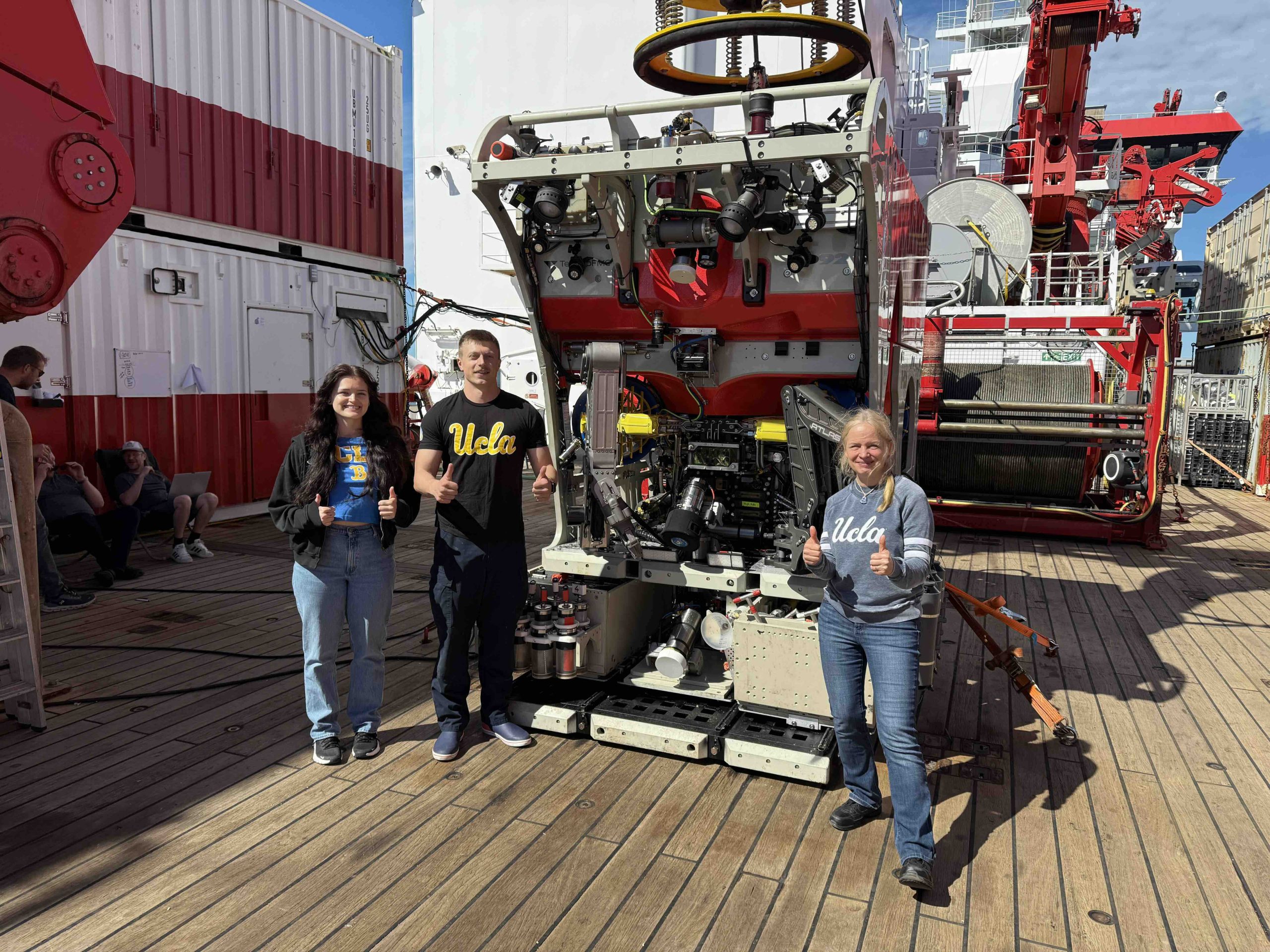
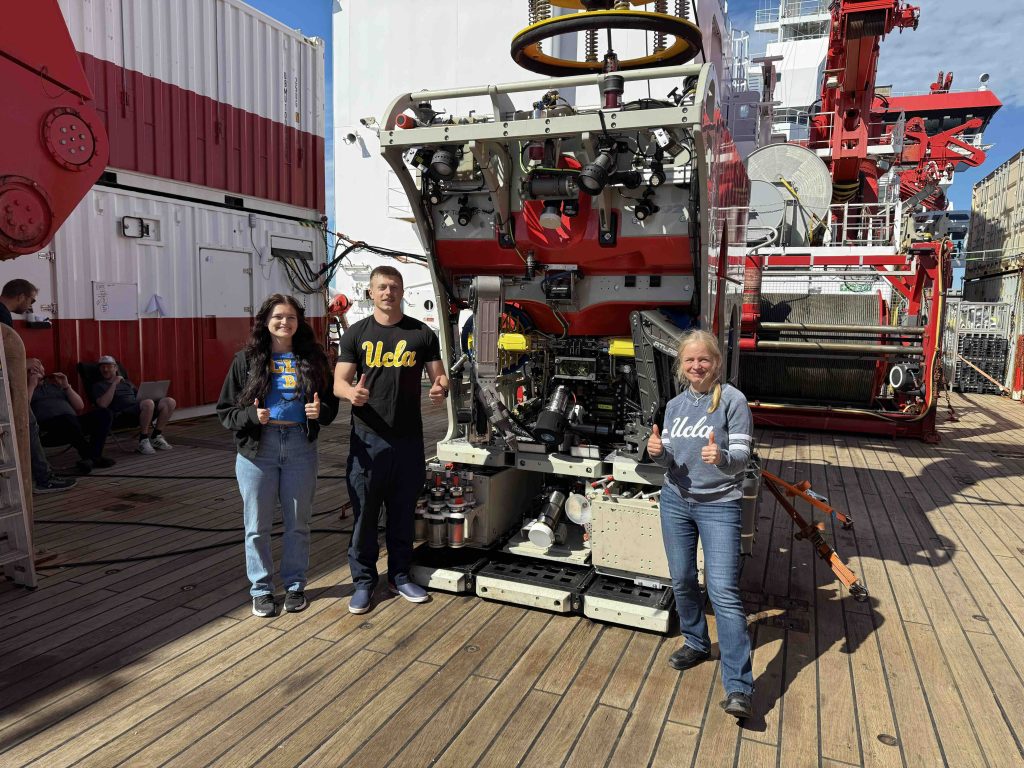
The UCLA team with the ROV MARUM-QUEST 5000 aboard the R/V Sonne, ready to investigate towering deep-sea barite mounds and the microbes that inhabit them.
Researchers from UCLA’s Department of Earth, Planetary, and Space Sciences are currently at sea aboard the German research vessel R/V Sonne as part of Expedition SO318. The expedition is led by MARUM – Center for Marine Environmental Sciences at the University of Bremen (Germany) under Dr. Gerhard Bohrmann and brings together an international team of scientists from the Monterey Bay Aquarium Research Institute (MBARI), Oklahoma State University, Oregon State University, Universidad Nacional Autónoma de México, and the University of California, Los Angeles.
During the 30-day expedition, researchers investigate extraordinary deep-sea barite (barium sulfate) deposits associated with cold seeps along the San Clemente fault system off Southern California and Baja California.
These mineral structures form where barium-rich fluids migrate upward along fault-related fractures and mix with sulfate-rich seawater at the seafloor, triggering barite precipitation. The resulting deposits create hard surfaces in otherwise sediment-covered environments and host distinctive microbial communities and chemosynthetic seep animals.
The UCLA Team: Methane, Microbes, and Mineral Mysteries
The UCLA team consists of Dr. Tina Treude and graduate students Rhegan Thomason, Maxwell Packebusch, and George Vetushko.
The group studies microorganisms that inhabit barite seep systems and investigates how their metabolic activity influences methane emissions from the seafloor. A central question is whether these microbial communities consume methane before it escapes into the ocean. Because barite (BaSO₄) contains sulfate within its mineral structure, the team examines whether sulfate released from barite can serve as an electron acceptor for microorganisms that oxidize methane. This research explores whether mineral-bound sulfate helps sustain methane-consuming microbial communities in fault-controlled seep environments.
At sea, the UCLA team collects sediment and mineral samples, conducts shipboard incubations, and prepares materials for detailed geochemical and microbiological analyses at UCLA.
Watch the ROV Dives Live
Expedition SO318, which continues until March 26, includes regular remotely operated vehicle (ROV) dives to explore the barite mounds and surrounding seep habitats. Live streams of the dives are broadcast approximately every 2–4 days via MARUM’s YouTube channel:
Please continue to check this website for updates as we may have to make modifications.
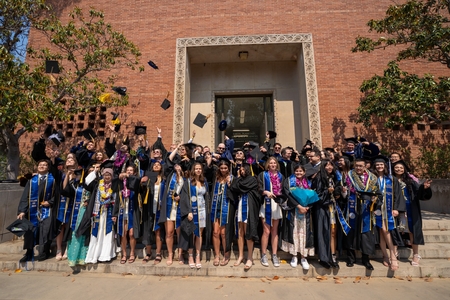
Join the Department of Earth, Planetary, and Space Sciences (EPSS) for our annual Commencement Ceremony honoring the accomplishments of graduating departmental students as they conclude this chapter of their academic journey.
Tickets are required for those attending in person.
Event Information
Our departmental commencement ceremony will take place on Sunday, June 14, 2026 at the Young Hall Patio.
Graduates will need to arrive by 12:00 PM to check in as the ceremony begins at 12:30 PM.
More information will be posted in early May.
Information about the College Commencement Ceremony can be found
here.
Ticket Information
Max guests per graduate: TBD
Allowed guests to be waitlisted: TBD (first-come, first-served basis)
Ticket price: TBD per person (graduating students attend for free)
Payment Deadline: TBD
Payment Method: Checks or cashier’s checks only, payable to UCLA Foundation
To purchase guest tickets or confirm waitlisted guests, please see Nanette in Room 3806 before the deadline.
Parking Information
We anticipate that parking will be impacted on the day of our event. Guests are encouraged to rideshare if possible.
For parking information, including campus parking maps, click
here.
To avoid long lines at the self-service pay stations on campus, it is recommended to purchase your parking permit through the
Bruin ePermit system
in advance of attending the Commencement ceremonies.
Day-of parking will also be available at various visitor parking locations using the self-service Pay Station machines or ParkMobile.
If you have questions, please email
transportation@ts.ucla.edu
or call (310) 794-7433.
Questions?
If you have any questions, please contact the EPSS Student Affairs Office.
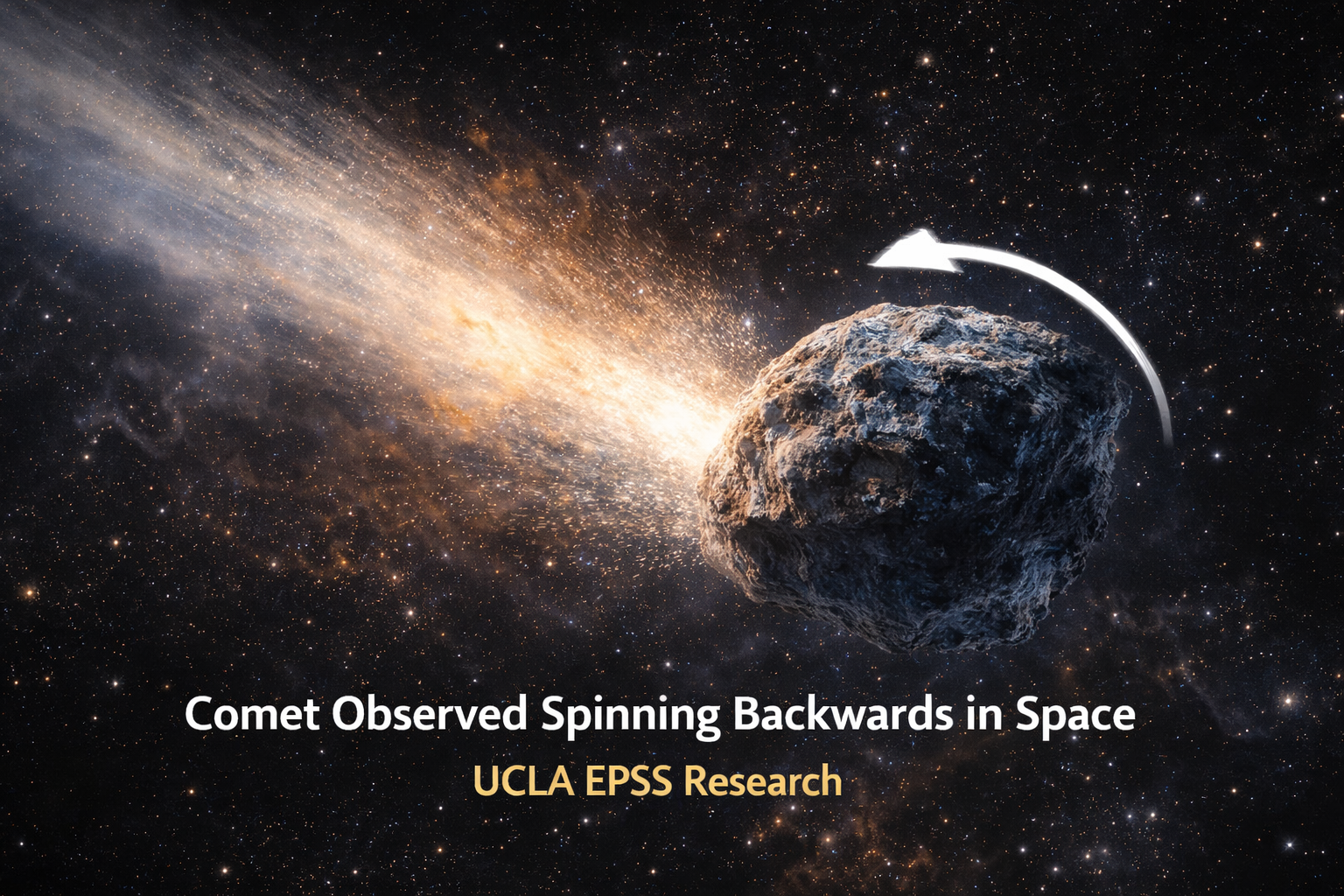
The New York Times recently featured research on Comet 41P/Tuttle–Giacobini–Kresák, highlighting findings from UCLA astronomer David Jewitt.
Astronomers have observed a comet exhibiting an unusual backward spin, offering new insight into the complex forces that shape the motion of small bodies in our solar system. The discovery provides valuable clues about comet dynamics and evolutionary processes in deep space.
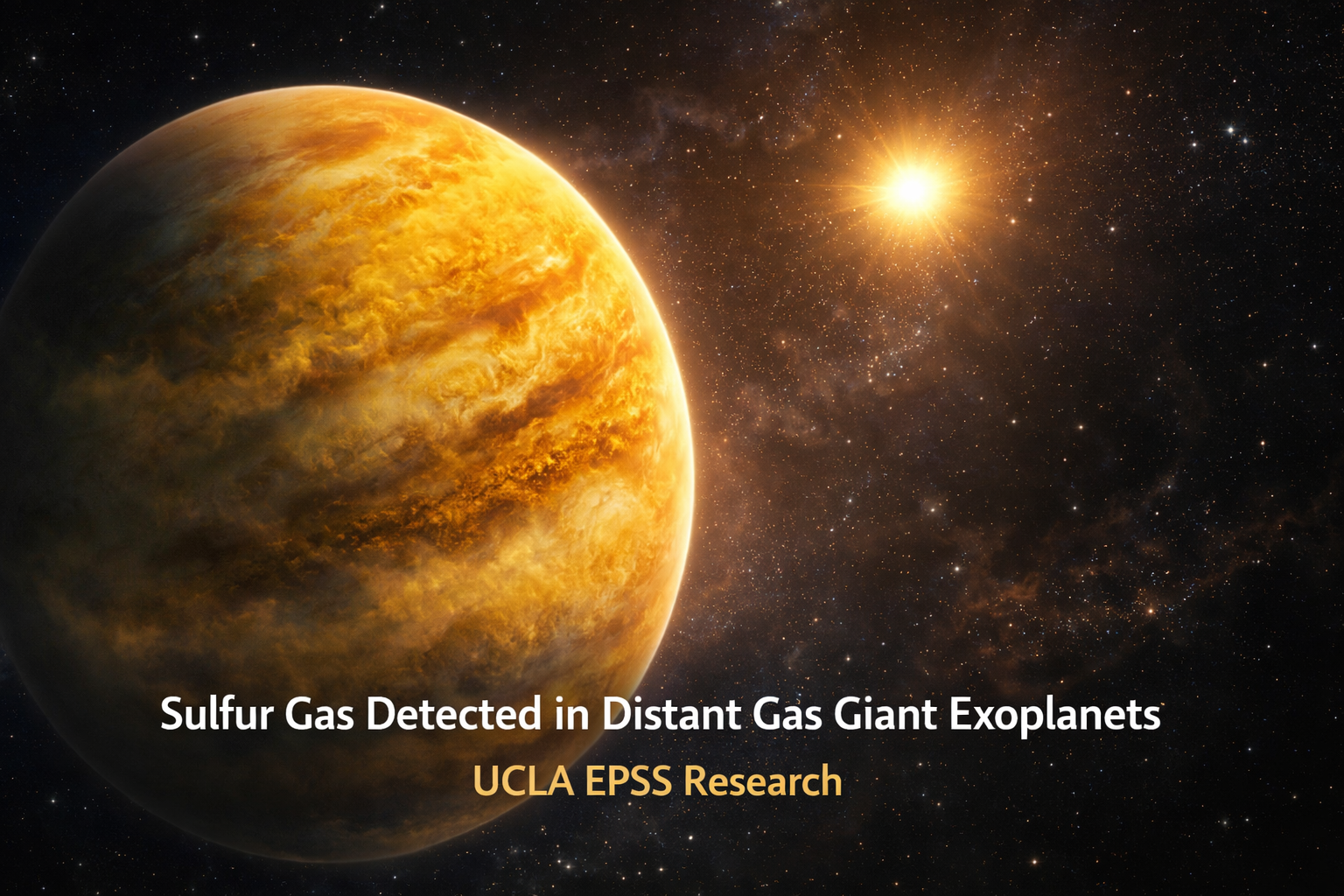
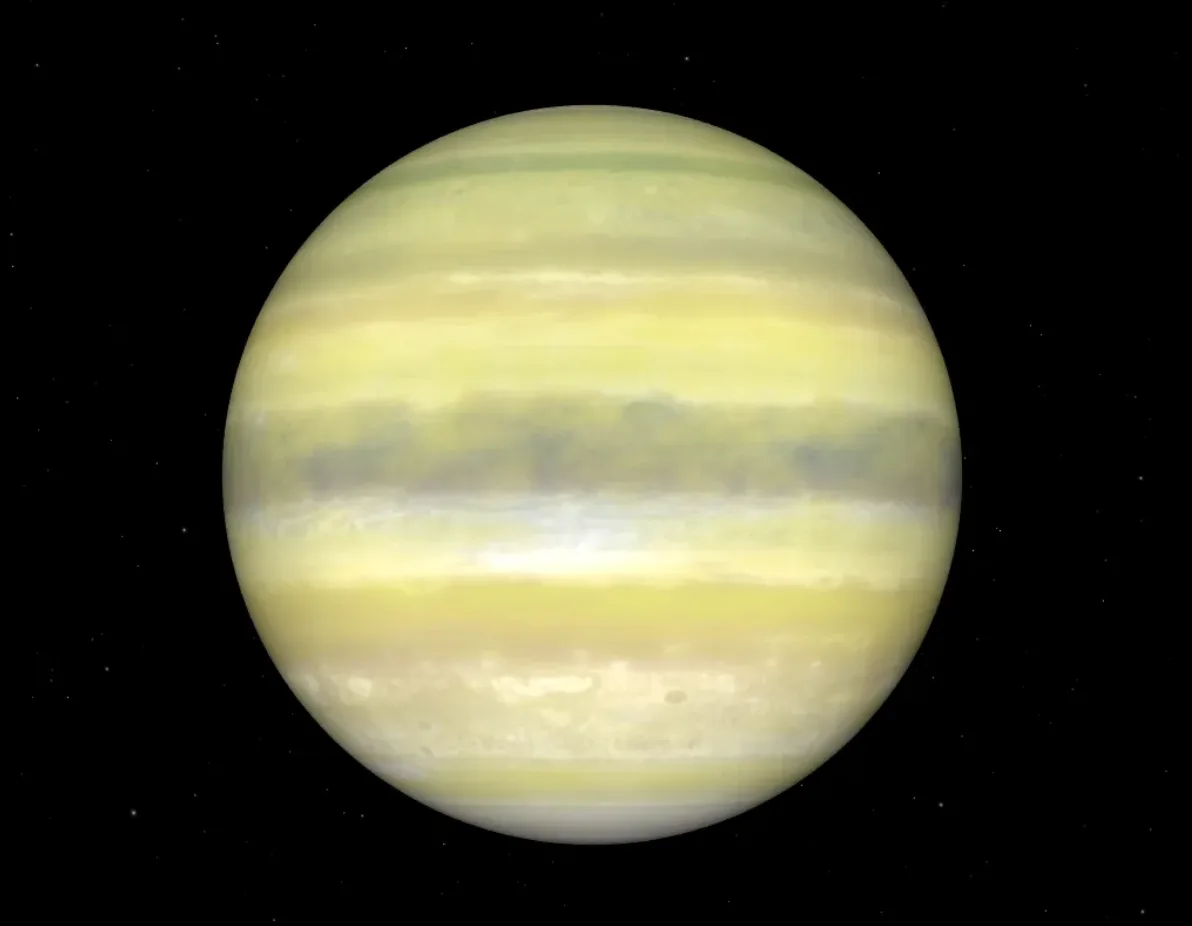
UCLA researchers have detected sulfur gas in the atmospheres of distant gas giant exoplanets, offering new insights into planetary chemistry and formation beyond our solar system. This discovery advances our understanding of atmospheric processes on massive worlds orbiting other stars.
Magma chambers are foundational elements of geology on Earth and rocky bodies in our solar system and beyond. They leak to the surface and produce volcanoes, or vent catastrophically and form calderas, or freeze in place and produce plutons that are the main building blocks of planetary crusts. The iconic image of a volcano connected to a shallow magma chamber has been seared into our minds owing to illustrations in thousands of books and journal articles. Surely there is no reason to question the existence of shallow magma chambers, right? I’m glad you asked. In this talk Allen F. Glazner will go over compelling geological and geophysical data that rule out the traditional view of magma chambers and offer an alternative view of crustal magmatism that is consistent with current data and explains several things that the traditional magma chamber paradigm cannot.
About the speaker: A native Southern Californian, Glazner earned geology degrees from Pomona College and UCLA before embarking on a 38-year career at the University of North Carolina at Chapel Hill, where he is a distinguished professor emeritus. Much of his recent work has focused on granites in the Sierra Nevada, with emphasis on Yosemite National Park. He has taught geology to astronauts and National Park personnel, and written “Geology Underfoot” books for the public on Yosemite, Southern California, and Death Valley and Eastern California. His textbook “Petrology and Plate Tectonics: An Earth Systems Approach” came out in 2025.