
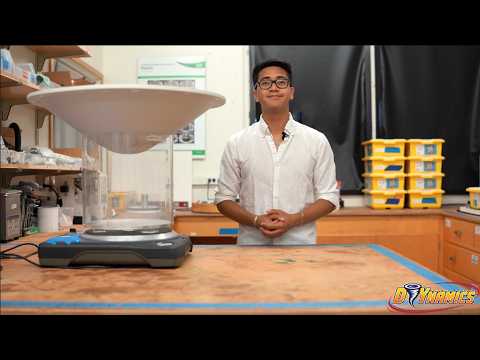
Have you ever wondered why circles and circular motion are so prevalent when observing geophysical dynamics? Between ocean currents, hurricanes, and even Jupiter’s Great Red Spot, circles are found everywhere within the realm of Earth and planetary phenomena.
This video dives into the world of motion in a rotating frame, with a real-world application being the rotating frame we live within — our rotating Earth! It discusses the Coriolis Force, which becomes the governing force driving a particle’s motion on an equipotential surface that is effectively flat. Normally in a rotating system, you’d also have centrifugal force and gravitational force coming into play, but on a surface where those two forces are balanced, you are able to really see the effect of Coriolis, as shown in this video.
For this experiment, all you really need is a rotating paraboloid and some free particles, such as the ball bearings used in the video. Do this experiment yourself in the lab and learn why circles keep popping up in Earth dynamics!
Part 1: Newton’s Bucket
Note: This video is Part 2 following the Newton’s Bucket video, which explains the backstory of the paraboloidal surface. The Newton’s Bucket experiment dives deeper into centrifugal force and gravity, so check that video out first and come back here after. You can also read the accompanying EPSS news post, Newton’s Bucket: Fluid in a Spinning Tank.