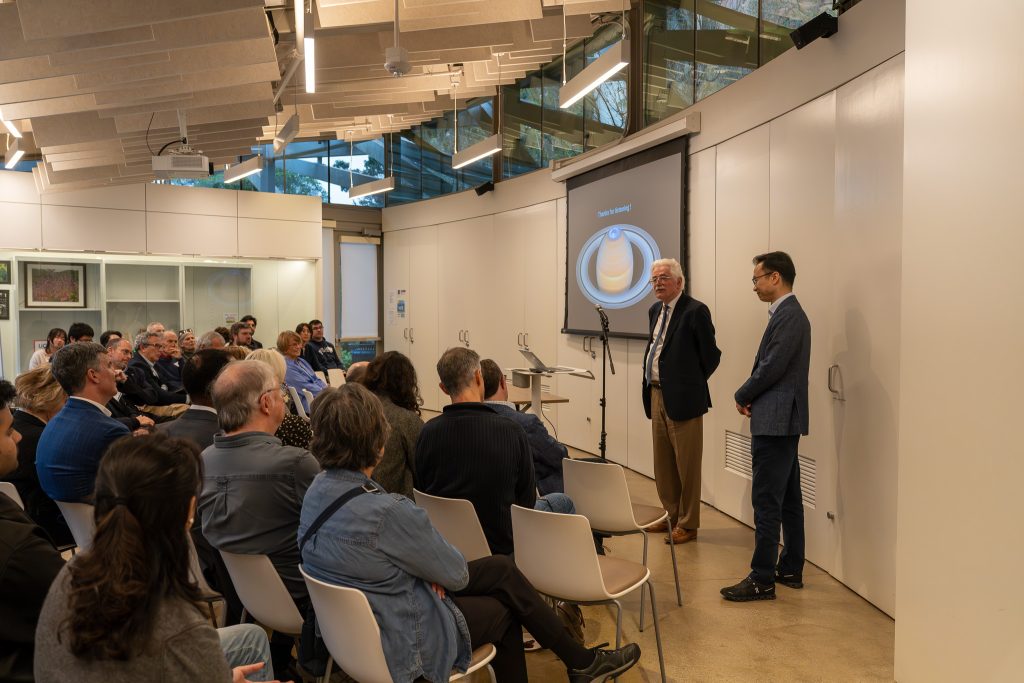
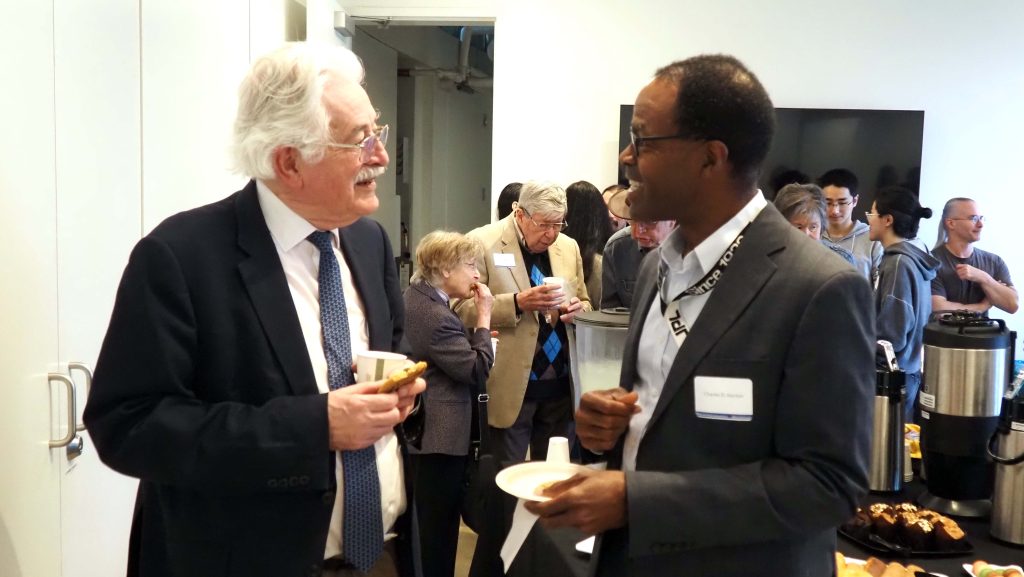
UCLA Department of Earth, Planetary and Space Sciences (EPSS) and the SPACE Institute recently hosted a special seminar featuring Prof. David J. Southwood CBE from the Physics Department at Imperial College London. Prof. Southwood, who served as Director of Science and Robotic Exploration at the European Space Agency for a decade, offered a timely perspective on how global space programs are shaped by science, economics and geopolitics.
In “ESA and NASA: A Tale of Two Space Agencies,” Prof. Southwood explored the contrasting approaches and priorities of NASA and ESA, highlighting the growing importance of space as both a scientific frontier and a driver of economic and strategic influence. He noted that Europe has used ESA to catch up with capabilities long established in the United States, particularly through its delivery of civil services in navigation (Galileo system) and Earth system monitoring (Copernicus).
Similarly, the satellite communications constellation IRIS2, currently being developed by ESA and the European Union, aims to ensure that European governments are not dependent on US-based systems such as Starlink, where access could be restricted under critical strategic circumstances.
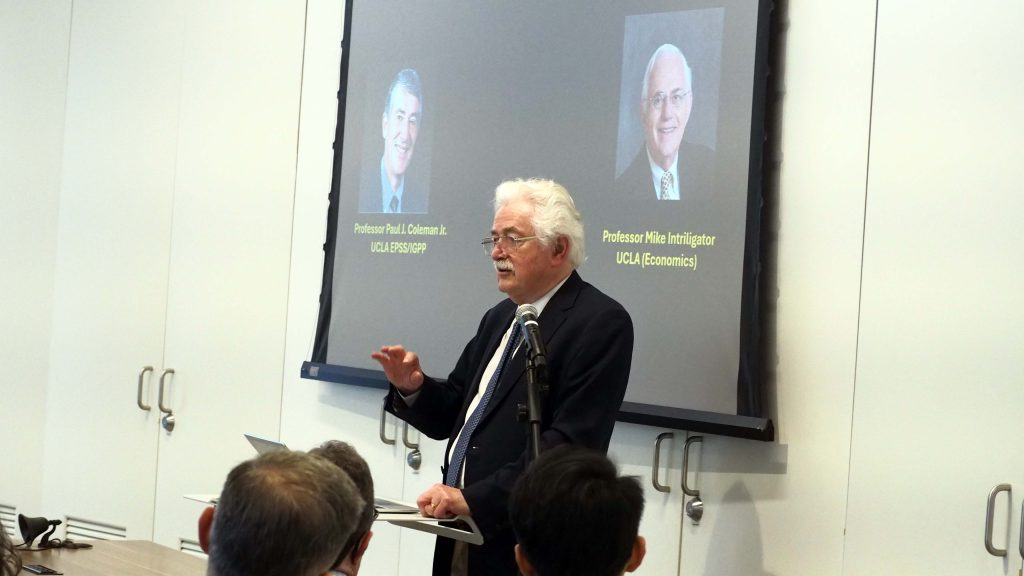
In his presentation, Prof. Southwood also acknowledged two mentors at UCLA, Prof. Paul J. Coleman Jr. (EPSS/IGPP) and Prof. Mike Intriligator (Economics), who inspired his early interest in space science, policy, and their societal impact. Prof. Southwood has a deep connection to UCLA EPSS. He was a postdoctoral scholar in the department from 1970 to 1971 with the late Prof. Paul J. Coleman, Jr. as his advisor. Over the following decades, he returned as a visiting professor, collaborating closely with Prof. Margaret G. Kivelson. Their joint publication in JGR: Space Physics in 2020 entitled “An Improbable Collaboration” (https://doi.org/10.1029/2020JA028407 (opens in a new tab)) reflects on their nearly half-century of scientific collaboration.
The event underscored UCLA EPSS’s longstanding leadership in space science and exploration, reflecting the department’s deep engagement with major space missions and its role in advancing research that helps define the future of the field.