
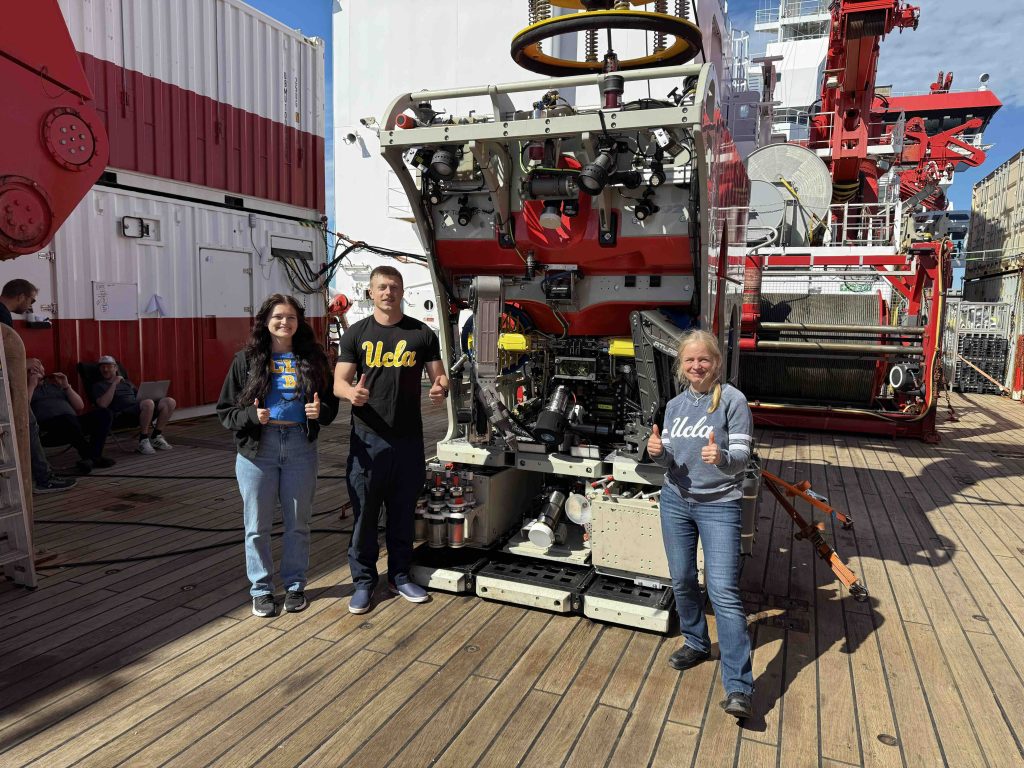
Researchers from UCLA’s Department of Earth, Planetary, and Space Sciences are currently at sea aboard the German research vessel R/V Sonne as part of Expedition SO318. The expedition is led by MARUM – Center for Marine Environmental Sciences at the University of Bremen (Germany) under Dr. Gerhard Bohrmann and brings together an international team of scientists from the Monterey Bay Aquarium Research Institute (MBARI), Oklahoma State University, Oregon State University, Universidad Nacional Autónoma de México, and the University of California, Los Angeles.
During the 30-day expedition, researchers investigate extraordinary deep-sea barite (barium sulfate) deposits associated with cold seeps along the San Clemente fault system off Southern California and Baja California.
These mineral structures form where barium-rich fluids migrate upward along fault-related fractures and mix with sulfate-rich seawater at the seafloor, triggering barite precipitation. The resulting deposits create hard surfaces in otherwise sediment-covered environments and host distinctive microbial communities and chemosynthetic seep animals.
More information about the expedition is available at:
https://www.marum.de/en/StartSO318.html
The UCLA Team: Methane, Microbes, and Mineral Mysteries
The UCLA team consists of Dr. Tina Treude and graduate students Rhegan Thomason, Maxwell Packebusch, and George Vetushko.
The group studies microorganisms that inhabit barite seep systems and investigates how their metabolic activity influences methane emissions from the seafloor. A central question is whether these microbial communities consume methane before it escapes into the ocean. Because barite (BaSO₄) contains sulfate within its mineral structure, the team examines whether sulfate released from barite can serve as an electron acceptor for microorganisms that oxidize methane. This research explores whether mineral-bound sulfate helps sustain methane-consuming microbial communities in fault-controlled seep environments.
At sea, the UCLA team collects sediment and mineral samples, conducts shipboard incubations, and prepares materials for detailed geochemical and microbiological analyses at UCLA.
Watch the ROV Dives Live
Expedition SO318, which continues until March 26, includes regular remotely operated vehicle (ROV) dives to explore the barite mounds and surrounding seep habitats. Live streams of the dives are broadcast approximately every 2–4 days via MARUM’s YouTube channel:
https://www.youtube.com/@marumTV