
Undergraduate · Accelerated master’s
Departmental Scholars Program
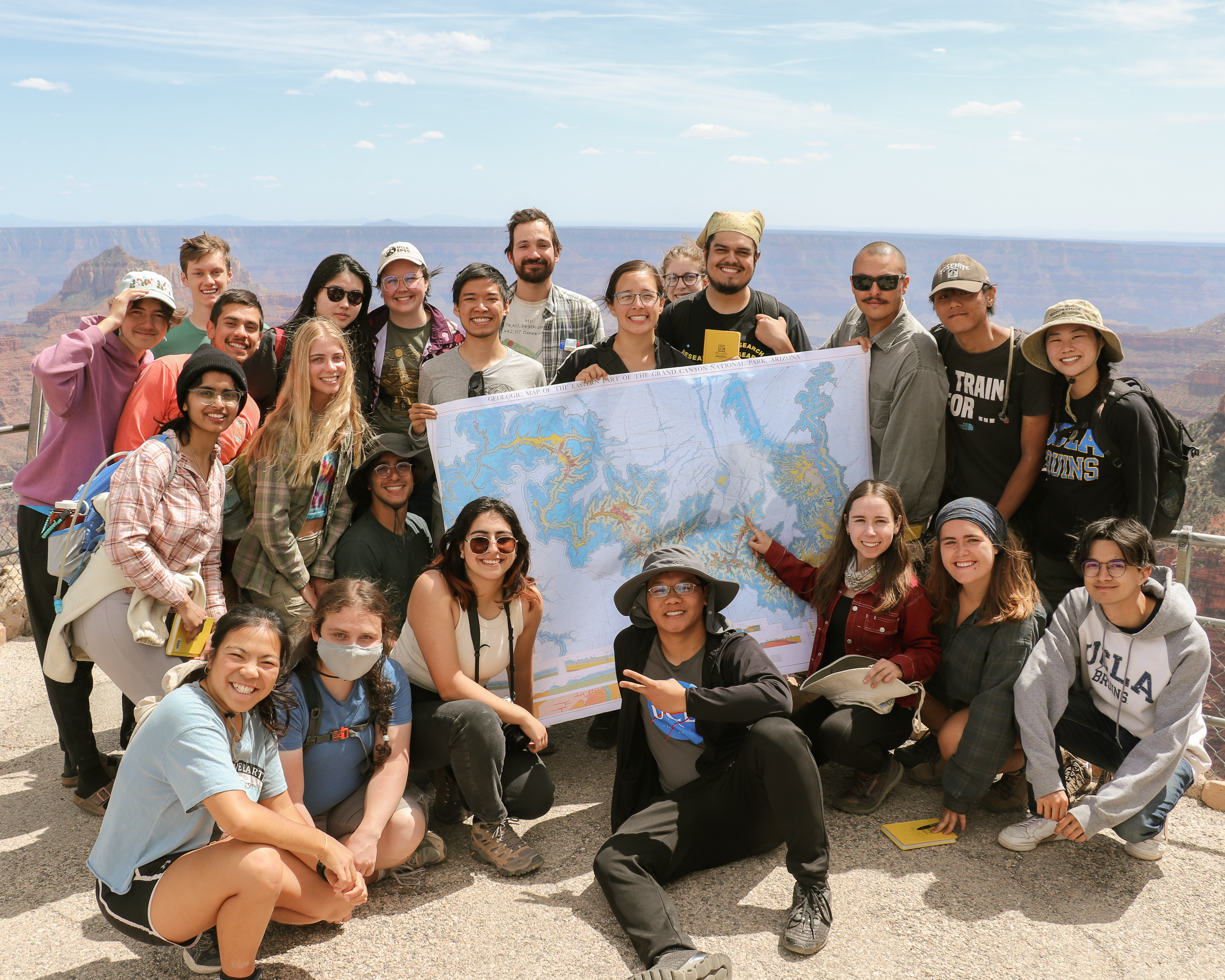
Earn your Bachelor of Science and Master of Science simultaneously with one additional year of graduate coursework and research.
Apply by December 15 of your final undergraduate year. Questions? Contact the Student Affairs Office via the Message Center or sao@epss.ucla.edu.
Overview
The Departmental Scholars Program (DSP) is designed for exceptionally promising undergraduates in the Department of Earth, Planetary, and Space Sciences. As an accelerated master’s program, the DSP allows students to earn their Bachelor of Science and Master of Science degrees simultaneously after completing one additional year of graduate level coursework and research.
To qualify for the DSP, students must already be conducting research with a faculty member in the department. While in the program, Departmental Scholars will maintain undergraduate status even though they are taking graduate level courses.
Eligibility Requirements
DSP students pursue an M.S. in one of the department’s graduate programs: Geology; Geophysics and Space Physics; or Planetary Science. Course plans are listed below and can be approved by your faculty advisor. Please schedule a meeting with College Honors (Lorena Rivera, lrivera@college.ucla.edu) if you need to file a petition to exceed maximum undergraduate units – same College Honors step used by other DSP departments.
- Completion of preparation for the major
- Completion of 24 courses (96 units) at UCLA or a similar institution. If any of these courses are from another institution, a copy of the transcript from the other institution must also be submitted in your application.
- 3.5 cumulative GPA, major GPA, and upper division major GPA. You can check this on your Degree Audit Report under the “Major Upper Division Courses GPA Requirement” heading.
- Research with an Earth, Planetary, and Space Sciences faculty member
Course Requirements (all EPSS M.S. tracks). DSP students complete the departmental M.S. requirements for their chosen track. Across EPSS M.S. programs:
- Nine graduate and upper-division courses (36 units) are required for the degree.
- At least six of those courses (24 units) must be 200-series courses taken for a letter grade.
- Up to 8 units of EPSS 596 (Directed Individual Study and/or Research) and/or EPSS 598 (M.S. Research and Thesis Preparation), where allowed by the track, may apply toward the 36-unit requirement.
- Undergraduate courses cannot be applied toward the M.S.
- Courses may not be applied twice (if a course is required for your B.S., it may not also count for the M.S.).
- Substitutions may be made with consent of the faculty advisor / area counselor as described for each track.
Note: If you are double majoring, your GPA for each major must meet these requirements. Please reach out to the Student Affairs Office to discuss your options if you do not meet the requirements for your non-EPSS department major.
Major: Geology
Nine graduate and upper division courses (36 units); at least six (24 units) must be 200-series for a letter grade. Up to 8 units of EPSS 596 may apply toward the total and graduate course requirement. (Catalog also notes up to 8 units of 500-series toward the M.S. total, with 4 units toward the minimum graduate course requirement.)
- Required: EPSS 61 (Geologic Maps) and EPSS 111 (Stratigraphic and Field Geology), unless equivalent courses were already passed elsewhere (waivers need adviser, Geology area counselor, and graduate adviser permission).
- Each quarter: enroll in a Geology, Geochemistry, or Geophysics seminar (EPSS 290A-C, 291A-C, or 295A-C) and present at least one lecture in that seminar each academic year.
- Each quarter: EPSS weekly colloquium (EPSS C293A, B, C).
Major: Geophysics and Space Physics
Nine graduate and upper division courses (36 units); at least six (24 units) must be 200-series for a letter grade. Up to eight units of EPSS 596 and/or EPSS 598 may apply toward the total and graduate course requirement.
- Required core: EPSS 200A (Solid Earth and Planets), 200B (Oceans and Atmospheres), and 200C (Plasmas).
- Three additional courses from the geophysics and space physics requirements satisfying the fundamental physics requirement from the following courses.
- EPSS 201 Classical Mechanics or PHYS 220: Classical Mechanics,
- EPSS 202 Continuum Mechanics
- EPSS 211 Mathematical Methods of Geophysics or one of PHYS 231A, B, C Methods of Mathematical Physics
- PHYS 210 A,B Electromagnetic Theory or AST 271 A, B Electromagnetic Radiation in Astrophysics I, II
- PHYS 215A Statistical Physics
- PHYS 221 A,B Quantum Mechanics or Chem 215A Quantum Chemistry Methods
- PHYS 222A Plasma Physics or AOS 250B Solar System Microscopic Plasma Processes
- AOS 201A Geophysics Fluid Dynamics I or MAE 250A Foundation of Fluid Dynamics
- CHEM 223A Classical and Statistical Thermodynamics
- EPS SCI M204 Time-Series Analysis; EPSS 205 Inverse Theory and Data Interpretation; EPSS 222 Introduction to Seismology
- Eight additional graduate-level units (recommended: 208, M224A); substitutions by petition in some cases
- Each quarter: seminar in a Geophysics and Space Physics subdiscipline (EPSS 292A-C Planetary Sciences; 295A-C Geophysics; M294A-C Space Physics; or 283A-C Space Physics Journal Club), with at least one lecture presented each academic year.
- Each quarter: EPSS weekly colloquium (EPSS C293A, B, C).
Major: Planetary Science
Nine graduate and upper division courses (36 units); at least six (24 units) must be 200-series for a letter grade. Up to eight units of EPSS 596 or EPSS 598 may count toward the 36 units.
- EPSS 200A Introduction to the Solid Earth and Planets
- EPSS 200B Introduction to Oceans and Atmospheres
- EPSS 200C Introduction to Plasmas-Aeronomy and the Interplanetary Medium
- EPSS 200D Planetary Surfaces
- EPSS 200E Planetary Origins & Evolution
Three courses from the department-approved list, including (examples): AOS 201A/B; EPSS 201, 202, 203, C206, C209, 210, 211, 219, 229; MAE 250A/B; PHY 210A/B, 215A/B, 220, 221A/B, 222A/B, 231A/B, 241A/B; CHM C213A/B, CHM C223A/B; AST 270, 271A/B, 281- then electives (200-series) to reach 36 units.
- Each quarter: seminar in a planetary science-related discipline (EPSS 292CA-C, 295A-C, M294A-C, or 283A-C), with at least one lecture presented each academic year.
- EPSS weekly colloquium (EPSS C293A, B, C)
How to Apply
Eligible students must submit a completed application, including letters of recommendation, by December 15 of their final year of undergraduate study. For example, a student planning to graduate with their bachelor’s degree in Spring 2027 should apply by December 15, 2026.
A completed application should include:
- Nomination form (Part I only) (opens in a new tab) — download, complete Part I, and upload as PDF in the application portal
- Statement of purpose (1–2 pages, PDF)
- Research abstract (1–2 pages, PDF)
- Unofficial transcript (PDF downloaded from MyUCLA)
- Two letters of recommendation (emailed by faculty; record who you asked in the portal checklist)
- One recommendation letter from an EPSS faculty advisor is required.
- One letter from faculty: tenured faculty, lecturers within EPSS, or adjunct faculty.
Submit application materials through the application portal below. Letters of recommendation should be emailed to Tasha Taylor (tasha@epss.ucla.edu) and CC the Student Affairs Office (sao@epss.ucla.edu). Applications are reviewed by area advisors. When the application is approved, an email notification is sent to the student and their faculty mentor.
Each student gets an isolated application with a tracking code, document checklist, recommendation checklist, and submission history. See current course offerings on the schedule of classes.
After you’re admitted
Steps for enrolled Departmental Scholars.
Enrolling in courses
Once your enrollment window is active, email the Student Affairs Office (sao@epss.ucla.edu) your requested courses along with your full name and UID number.
Thesis filing workshop
All DSP students are required to attend a Master’s Thesis & Doctoral Dissertation Filing workshop during winter or spring quarter. If spring quarter dates are not yet posted, check closer to spring quarter.
Thesis and dissertation filing workshops (opens in a new tab)
Graduation paperwork
Submit the following forms to the Student Affairs Office before completing the program:
Nomination of Master’s Thesis Committee (opens in a new tab)
The thesis committee must be appointed at the beginning of the spring quarter. Your faculty advisor serves as committee chair; select at least two additional faculty members. Review the committee requirements on the form so your committee meets Division of Graduate Education (DGE) rules.
Master’s Advancement to Candidacy Petition (opens in a new tab)
Complete this after DGE appoints your committee, by the second week of spring quarter. For processing time, turn the form in to the Student Affairs Office by Week One of your intended graduating quarter.
The master’s committee approves your thesis online via ETD by the required deadline. See File your thesis or dissertation (opens in a new tab).